
How to Do Keyword Research Using AI Tools (2026 Beginner's Guide)
AI keyword research | Keyword research using AI | AI SEO tools

Introduction
How to Do Keyword Research Using AI Tools in 2026. It is very important to understand Keyword research is one of the most important steps in a successful SEO strategy. Before creating a blog post, website page, it is very essential you need to understand what people are searching for, how they search, and what type of content they expect to find. How to Do Keyword Research Using AI Tools, traditionally keyword research involved manually checking search volumes, competition, related keywords, and competitor websites. However, AI has made keyword research faster, easier, and more strategic.
Thank you for reading this post, don't forget to subscribe!But today, you can use AI tools to discover keyword ideas, find long-tail and low-competition keywords, understand search intent, analyze keyword relationships, and create content topics based on what your target audience is looking for. This is it, How to Do Keyword Research Using AI Tools and makes keyword research using AI especially useful for bloggers, small businesses, freelancers, digital marketers, and beginners who may not have extensive SEO experience.
In this guide, How to Do Keyword Research Using AI Tools (2026 Beginner’s Guide), you will learn a simple step-by-step process for using AI for keyword research. We will explore how to find the right seed keyword, generate relevant keyword ideas, analyze search intent, identify long-tail opportunities, organize keywords into clusters, and select keywords that can support your SEO goals.
You will also learn how AI keyword research tools can work alongside traditional SEO tools to create a more effective AI SEO workflow. The goal is not simply to find keywords with high search volume, but to discover relevant keywords that match user intent and give your website realistic opportunities to attract targeted organic traffic.
Whether you are starting your first blog, improving an existing website, or developing an SEO strategy for your business, learning how to use AI for keyword research can save time and help you make smarter content decisions.
Importance of Keyword Research
Before writing any article, you need to know what people are searching for and how to do keyword research using AI tools in 2026.
The importance of Proper keyword research helps you:
- Increase organic traffic
- Rank higher on Google
- Understand customer intent
- Create content people actually want
- Improve website authority
- Reduce guesswork in SEO
Without keyword research, even the best-written content may never reach its audience.
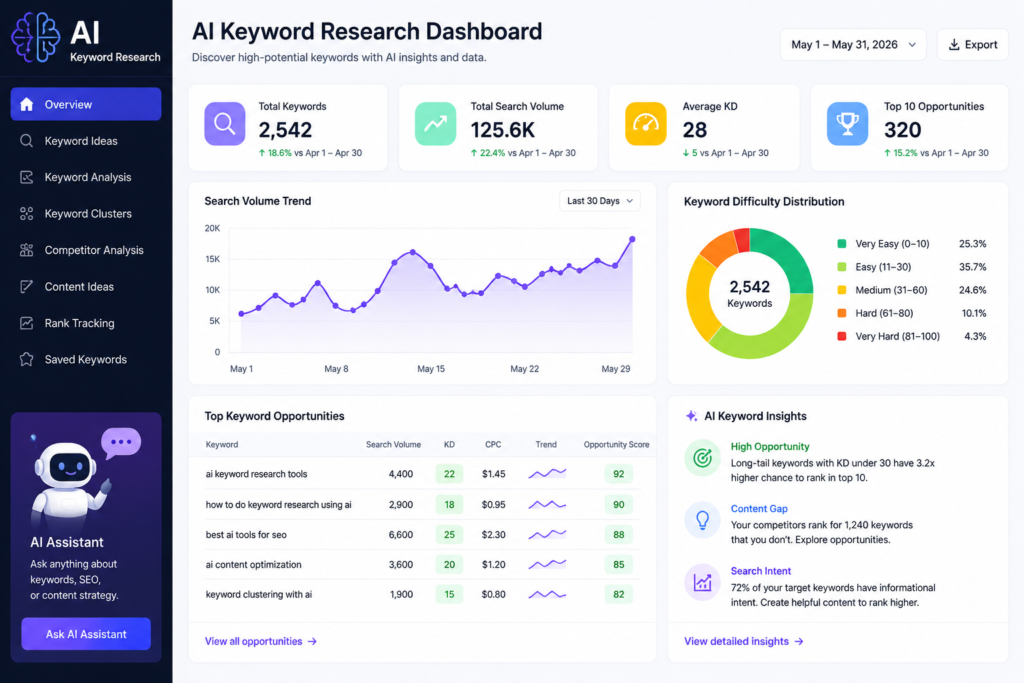
What Is AI Keyword Research?
AI keyword research is how to do keyword research using AI tools in 2026 and how Artificial Intelligence to discover, organize, and analyze keywords based on user search trends, competition, and ranking opportunities.
Unlike traditional keyword tools that only display keyword data, AI tools can also:
- Suggest related keywords
- Group keywords into clusters
- Predict search intent
- Recommend content structure
- Generate blog topic ideas
- Identify ranking gaps
This makes AI significantly faster and smarter than manual research and defines how to do keyword research using AI tools in 2026 .
Benefits of Using AI for Keyword Research
1. Faster Research
AI analyzes thousands of keyword combinations in seconds.
2. Better Search Intent Analysis
AI understands whether users want information, products, services, or comparisons.
3. Long-Tail Keyword Discovery
Long-tail keywords usually have lower competition and higher conversion rates. For Example:
Instead of AI SEO,
You can use : How to use AI for SEO in small businesses.
4. Content Gap Identification
AI identifies keywords your competitors rank for but you don’t.
5. Topic Clustering
AI groups similar keywords together, making internal linking and topical authority easier.
The above benefits shows How to do keyword research using AI tools
Step-by-Step Guide to Keyword Research Using AI Tools
Step 1: Choose a Seed Keyword
Start with a broad topic related to your niche.
Examples:
- AI SEO
- Digital Marketing
- WordPress
- Cricket Coaching
- Website Development
The AI tool will expand this into hundreds of keyword ideas.
Step 2: Generate Keyword Ideas
Use AI to generate:
- Related keywords
- Questions
- Long-tail keywords
- Comparison keywords
- Local keywords
Example for AI SEO:
- AI SEO tools
- AI SEO software
- AI SEO for beginners
- AI SEO guide
- AI SEO tips
- AI SEO strategy
- AI content optimization
- AI keyword clustering
Step 3: Analyze Search Intent
Every keyword belongs to one of four search intents:
Informational
Example:
- What is AI SEO?
Navigational
Example:
- ChatGPT SEO
Commercial
Example:
- Best AI SEO tools
Transactional
Example:
- Buy AI SEO software
Creating content that matches user intent improves rankings and engagement.
Step 4: Check Keyword Difficulty
AI tools estimate how difficult it is to rank for a keyword.
For beginners, target:
- Low competition
- Medium search volume
- High relevance
These keywords provide the best opportunity to gain organic traffic.
Step 5: Find Long-Tail Keywords
Long-tail keywords generally have:
- Lower competition
- Better conversion rates
- Higher ranking potential
Example:
Instead of:
AI Tools
Try:
Best AI tools for keyword research in 2026
Step 6: Group Keywords into Clusters
Rather than writing one article per keyword, group similar keywords together.
Example Cluster:
Main Keyword:
- AI Keyword Research
Supporting Keywords:
- AI keyword generator
- AI SEO tools
- Keyword clustering
- AI content planning
- SEO keyword research
Google rewards websites that build topical authority through related content.
Best AI Keyword Research Tools
Several AI-powered tools can simplify keyword research:
- ChatGPT – Brainstorm keyword ideas, search intent, and content outlines.
- Google Keyword Planner – Free search volume and keyword ideas.
- Ahrefs – Keyword difficulty, backlinks, and competitor analysis.
- SEMrush – Comprehensive SEO and keyword tracking.
- Ubersuggest – Beginner-friendly keyword research.
- Keyword Insights – AI-powered keyword clustering.
- Surfer SEO – Content optimization with AI recommendations.
Using two or three tools together often provides the most reliable insights.
Common Mistakes to Avoid
Avoid these common errors:
- Choosing only high-volume keywords
- Ignoring search intent
- Stuffing keywords unnaturally
- Not using long-tail keywords
- Skipping competitor analysis
- Publishing without internal links
- Forgetting to update older content
A balanced keyword strategy is more effective than chasing only popular terms.
AI Keyword Research Workflow
Follow this simple workflow:
- Choose a seed keyword.
- Generate keyword ideas with AI.
- Identify search intent.
- Check keyword difficulty and search volume.
- Select long-tail opportunities.
- Organize keywords into clusters.
- Create high-quality content.
- Optimize on-page SEO.
- Add internal links.
- Monitor rankings and update content regularly.
This process helps build a strong content strategy that supports long-term SEO growth.
Conclusion
AI has transformed keyword research from a time-consuming manual task into a faster, more strategic process. By combining AI tools with a clear understanding of user intent and SEO best practices, you can uncover valuable keyword opportunities, create content that answers real search queries, and build topical authority over time.
Remember that AI should assist your research—not replace your expertise. Focus on creating helpful, accurate, and original content around the keywords you discover. As search engines continue to evolve, websites that consistently publish high-quality, user-focused content backed by smart AI-driven keyword research will be in the strongest position to earn sustainable organic traffic.
If you’re just getting started, begin with one seed keyword, explore AI-generated suggestions, and publish one well-optimized article. Consistency and continuous improvement are the keys to long-term SEO success.
Frequently Asked Questions (FAQ'S)
1. Can AI replace traditional keyword research?
AI speeds up keyword discovery and analysis, but human judgment is still needed to choose the most relevant keywords and create valuable content.
2. Which AI tool is best for beginners?
ChatGPT combined with Google Keyword Planner and Ubersuggest offers an excellent starting point for beginners.
3. Are long-tail keywords better than short keywords?
Long-tail keywords usually have lower competition, better search intent, and higher conversion potential, making them ideal for newer websites.